| klste@hotmail.de |
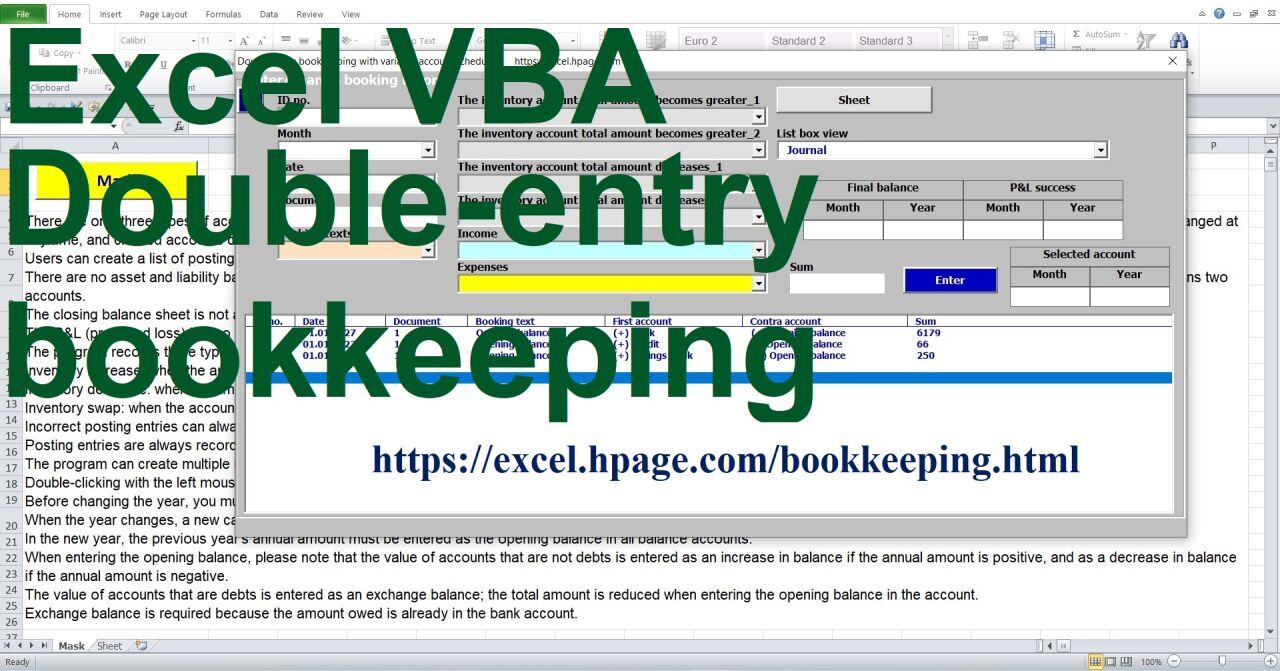
Double-entry bookkeeping with variable chart of accounts. Here's how it works.
There are only three types of accounts here: inventory accounts, income accounts, and expense accounts. Users can create 224 accounts for each type. The names of created accounts can be changed at any time, and created accounts can also be deleted.
Here, users can create a list of booking texts; when recording a transaction, the text is selected from the list rather than being entered manually.
There is no distinction here between asset and liability accounts; instead, there are simply accounts where the total amount increases or decreases within a journal entry. Each journal entry involves two accounts.
Using this accounting program begins with entering the opening balance. Here is how the opening balance is recorded:
For an account with a bank balance, the amount should increase, and for the account with the opening balance, the amount should also increase. This results in an increase in the balance. The amount shown in the journal entry is also carried over to the final balance sheet.
When you enter the opening balance of a loan, the amount in the loan account should increase, while the amount in the opening balance account decreases.
This constitutes an asset/liability exchange—specifically, an exchange of balance sheet items—because the borrowed amount is already in the bank account. The amount specified in the journal entry does not appear in the final balance sheet.
The opening balance of income and expense is not entered.
The program records three types of business transactions:
An increase in assets/liabilities occurs when the balances of two accounts rise and the accounts involved are either two balance sheet accounts or one balance sheet account and one revenue account. This happens, for example, when taking out a loan or transferring wages. The total amount in the final balance increases.
A reduction in assets occurs when the amounts in both accounts are decreased and the accounts involved are either two asset accounts or one asset account and one expense account. This happens, for example, during loan repayments or the purchase of household goods. The amount recorded in the journal entry is deducted from the final balance.
An asset exchange occurs when the accounts involved are two asset accounts, with the balance of one increasing and the balance of the other decreasing. This happens, for example, when transferring money from a bank account to a savings book account or vice versa. There is no change to the final balance.
The final balance in the program is not an account; the final balance is the sum of all increase in assets minus the sum of all reduction in assets.
P&L (profit and loss) is not an account here either; P&L is the final result of revenue less costs.
Incorrect booking entries can always be deleted; the password for deletion is the number 3.
Booking entries are always recorded in the selected month. The annual result is calculated after every booking entry.
The program can create multiple evaluations of the entered data.
Double-clicking a row in the list box with the left mouse button selects that row, and the data from the selected row appears in the combo boxes.
Before changing the year, you must access the current "Inventory accounts_list" report. The sheet containing the report should be saved as a PDF file.
When the year changes, a new calendar is created and all booking entries are deleted; the password is the number 3.
At the start of the New Year, the previous year's closing balance must be entered as the opening balance for all asset and liability accounts.
When entering the opening balance, note that for accounts representing assets (non-debt accounts), a positive annual figure is recorded as an increase in assets, while a negative figure is recorded as a decrease.
For accounts representing liabilities (debt accounts), the value is recorded as an exchange of assets/liabilities; the total opening balance figure decreases upon entry.
This is classified as an exchange because the amount owed is already reflected in the bank account.
The opening balance has been correctly recorded if the final balance of the previous year corresponds to the final balance of the New Year.
Retail. Double-entry bookkeeping with variable chart of accounts.
Private investment. Retail. Double-entry bookkeeping with variable chart of accounts.
A retailer transfers 50,000 euros from their personal account to their business bank account.
Two accounts are involved: Private and Bank.
This transaction represents an increase in assets.
An increase in assets occurs when the balances of two accounts rise and the accounts involved are either two balance sheet accounts or one balance sheet account and one revenue account. The total amount in the final balance sheet also increases.
Take out a loan. Retail. Double-entry bookkeeping with variable chart of accounts.
The retailer receives a loan of 100,000 euros from a bank, which is transferred to their business account.
Two accounts are involved: Credit and Bank.
This transaction represents an increase in assets.
An increase in assets occurs when the balances of two accounts rise and the accounts involved are either two balance sheet accounts or one balance sheet account and one revenue account. The total amount in the final balance sheet also increases.
Purchase of merchandise. Retail. Double-entry bookkeeping with variable chart of accounts.
The retailer purchases and pays for merchandise worth 100,000 euros plus 19,000 euros in Value Added Tax.
Three accounts are affected: Bank, Merchandise, and Input Tax.
In this program, only two accounts are used per journal entry; therefore, payment for merchandise is recorded in two journal entries.
Merchandise and Bank. This entry represents an exchange of assets.
The balance of the Merchandise account increases and the balance of the Bank account decreases. There is no change to the final balance sheet.
Input Tax and Bank. This entry represents an exchange of assets.
The balance of the Input Tax account increases and the balance of the Bank account decreases. There is no change to the final balance sheet.
Take out merchandise. Retail. Double-entry bookkeeping with variable chart of accounts.
The retailer withdraws merchandise worth 50,000 euros from inventory for resale.
Two accounts are involved: Merchandise Inventory account and expense account Merchandise. This booking represents a reduction in inventory.
The balance in the Merchandise Inventory account decreases and the amount in the Merchandise expense account increases.
The amount recorded in the journal entry is deducted from the final balance.
The amount specified in the journal entry is deducted from the P&L (profit and loss).
Sale of merchandise. Retail. Double-entry bookkeeping with variable chart of accounts.
The retailer sells merchandise worth 200,000 euros plus 38,000 euros in Value Added Tax.
Three accounts are affected: Bank, Output Tax, and income account Merchandise.
In this program, only two accounts are used per journal entry; therefore, the receipt of payment for merchandise is recorded in two journal entries.
Bank and Output Tax. This entry represents an increase in assets.
The balance of the Bank account increases and the balance of the Output Tax account increases. The total amount in the final balance sheet also rises.
Bank and revenue account Merchandise. This entry represents an increase in inventory.
The balance of the Bank account increases and the balance of the income account Merchandise. The total amount in the final balance sheet also rises.
The amount specified in the journal entry is allocated to the P&L (profit and loss) account.
Calculation of tax liabilities. Retail. Double-entry bookkeeping with variable chart of accounts.
The retailer offsets a portion of the Input Tax amounting to 10,000 euros against the Output Tax.
Two accounts are affected: Input Tax and Output Tax. This entry represents a reduction in assets.
The balance on the Input Tax account decreases and the balance on the Output Tax account also decrease.
The amount shown in the journal entry is deducted from the Final balance sheet.
Payment of interest on a credit. Retail. Double-entry bookkeeping with variable chart of accounts.
The retailer pays 1,000 euros in interest on the credit taken out.
Two accounts are involved: Bank Inventory account and expense account Interest. This booking represents a reduction in inventory.
The balance in the Bank Inventory account decreases and the amount in the Interest expense account increases.
The amount recorded in the journal entry is deducted from the final balance.
The amount specified in the journal entry is deducted from the P&L (profit and loss).
Credit repayment. Retail. Double-entry bookkeeping with variable chart of accounts.
The retailer repays a portion of the loan taken out, amounting to 50,000 euros.
Two accounts are involved: Bank account and account Credit. This booking represents a reduction in inventory.
The balance in the Bank account decreases and the balance in the Credit account also decrease.
The amount recorded in the journal entry is deducted from the final balance.
Private withdrawal. Retail. Double-entry bookkeeping with variable chart of accounts.
The retailer transfers 20,000 euros from the business bank account to his personal account.
Two accounts are involved: Bank and Private. This booking represents a reduction in inventory.
The balance in the Bank account decreases and the balance in the Private account also decrease.
The amount recorded in the journal entry is deducted from the final balance.
Change year. Retail. Double-entry bookkeeping with variable chart of accounts.
This program processes data for only one year.
At the beginning of a new year, the opening balances of all active inventory accounts are recorded.
Before the opening balance is entered, the current "Inventory accounts_list" report should be opened. The report sheet should be saved as a PDF file.
The year is being changed. When the year changes, a new calendar is created and all booking entries are deleted; the password is the number 3.
Entry of the opening balance. Retail. Double-entry bookkeeping with variable chart of accounts.
The opening balance of each inventory account is the year balance of that account from the previous year.
Bank and Opening balance. This entry represents an increase in assets. The balance of the Bank account increases and the balance of the Opening balance account increases. The total amount in the final balance sheet also rises.
Privates and Opening Balance. The Private account contains liabilities that were credited to the Bank account. This transaction represents an asset exchange. The balance of the Private account increases, while the balance of the Opening Balance account decreases. The total amount in the final balance sheet also rises.
Credit and Opening Balance. The Credit account contains liabilities that were credited to the Bank account. This transaction represents an asset exchange. The balance of the Credit account increases, while the balance of the Opening Balance account decreases. There is no change to the final balance sheet.
Merchandise and Opening balance. The Merchandise account includes the amount credited to it from the Bank account. The balance of the Merchandise account increases and the balance of the Opening balance account increases. The total amount in the final balance sheet also rises.
Input Tax and Opening balance. The Input Tax account includes the amount credited to it from the Bank account. The balance of the Input Tax account increases and the balance of the Opening balance account increases. The total amount in the final balance sheet also rises.
Output Tax and Opening Balance. The Output Tax account contains liabilities that were credited to the Bank account. This transaction represents an asset exchange. The balance of the Output Tax account increases, while the balance of the Opening Balance account decreases. There is no change to the final balance sheet.
The opening balance has been correctly recorded if the final balance of the previous year corresponds to the final balance of the New Year.